Design Thinking
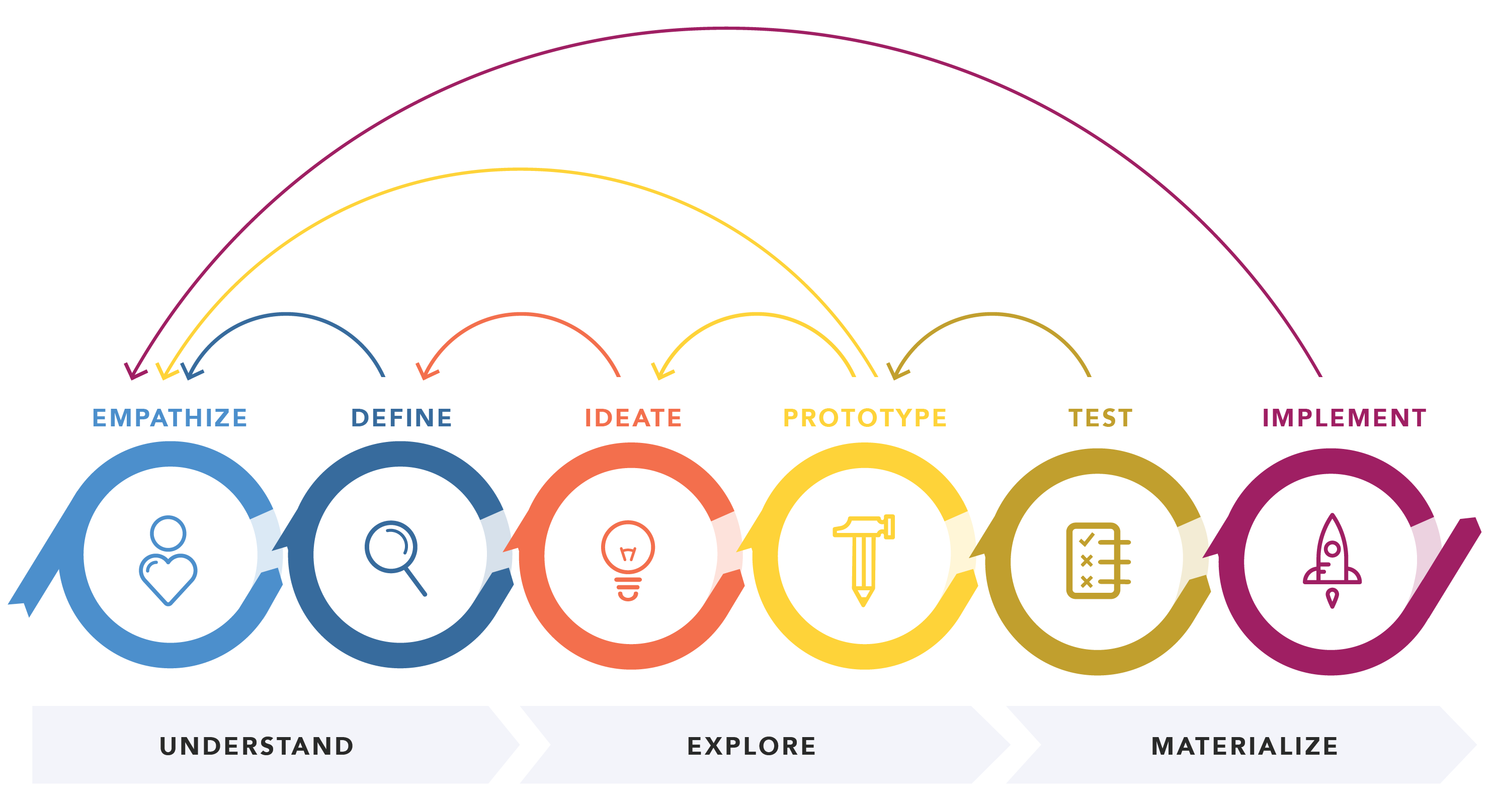
Design thinking is a non-linear, iterative process that teams use to understand users, challenge assumptions, redefine problems and create innovative solutions to prototype and test. This method, which entails five steps (Empathize, Define, Ideate, Prototype, and Test), is particularly beneficial when used to problems that are unclear or unidentified.
Empathise: Learners observe, participate, watch, and listen. Understanding individuals in the context of their design challenge is the goal. Who are they creating for, and what issue does the design attempt to address?
Define: Based on their fresh perspective on the issue and the people involved, learners specifically define the difficulty. They formulate an insightful problem statement to direct their efforts.
Ideate: Students come up with ideas. Any concept is acceptable. The team suspends judgement in order to investigate novel concepts and advance past simple fixes.
Prototype: Students begin developing their solution with the user in mind. Failure is accepted in this iterative process. Prototypes don't need a lot of time or money invested in them.
Test: Students ask end users for feedback on their prototypes. It's a chance to: develop empathy for and understanding of the target market; improve prototypes and solutions.
Think about how quickly things are changing in our world. Students will need to be flexible and adaptive if they want to succeed in the future. They will need to be ready to deal with circumstances they have never encountered before. One of the best tools we can give our students is Design Thinking, which will help them to achieve the following aims: Develop as positive, empathetic, and active members of society who can help to solve the complex problems the world faces; Have creative confidence in their abilities to adapt and respond to new challenges.
SAMR
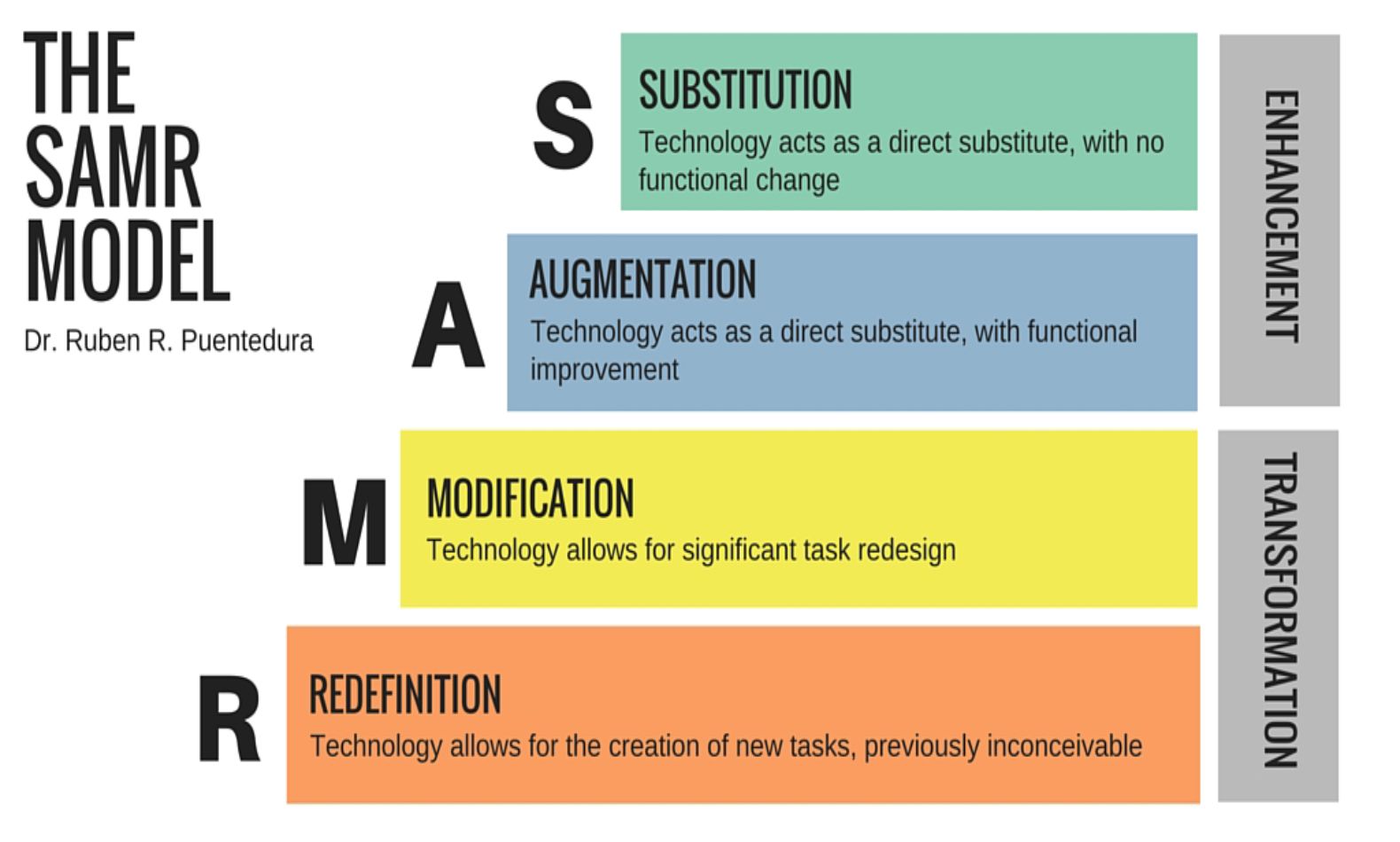
Dr. Ruben Puentedura developed a framework called the SAMR Model that divides classroom technology integration into four separate levels. Substitution, Augmentation, Modification, and Redefinition are all abbreviated as "SAMR." In order to help teachers personalise learning and aid pupils in visualising challenging topics, the SAMR model was developed. When integrated classroom technology makes teaching and learning for both teachers and students more smooth, such as during remote and blended learning, the SAMR Model can be particularly effective.
The SAMR approach is frequently pictured as a ladder or stairway, as shown, however this can be misleading because Substitution (the bottom rung or step) is occasionally the greatest option for a given lesson. For this reason, it's preferable to consider the SAMR model as more of a spectrum. On the one hand, technology is utilised to replace old tools exactly, and on the other, it makes experiences possible that would not have been conceivable without it.
Whatever way you see it, the SAMR framework can be a quick and easy tool to evaluate how you use technology in your education.
TPAK
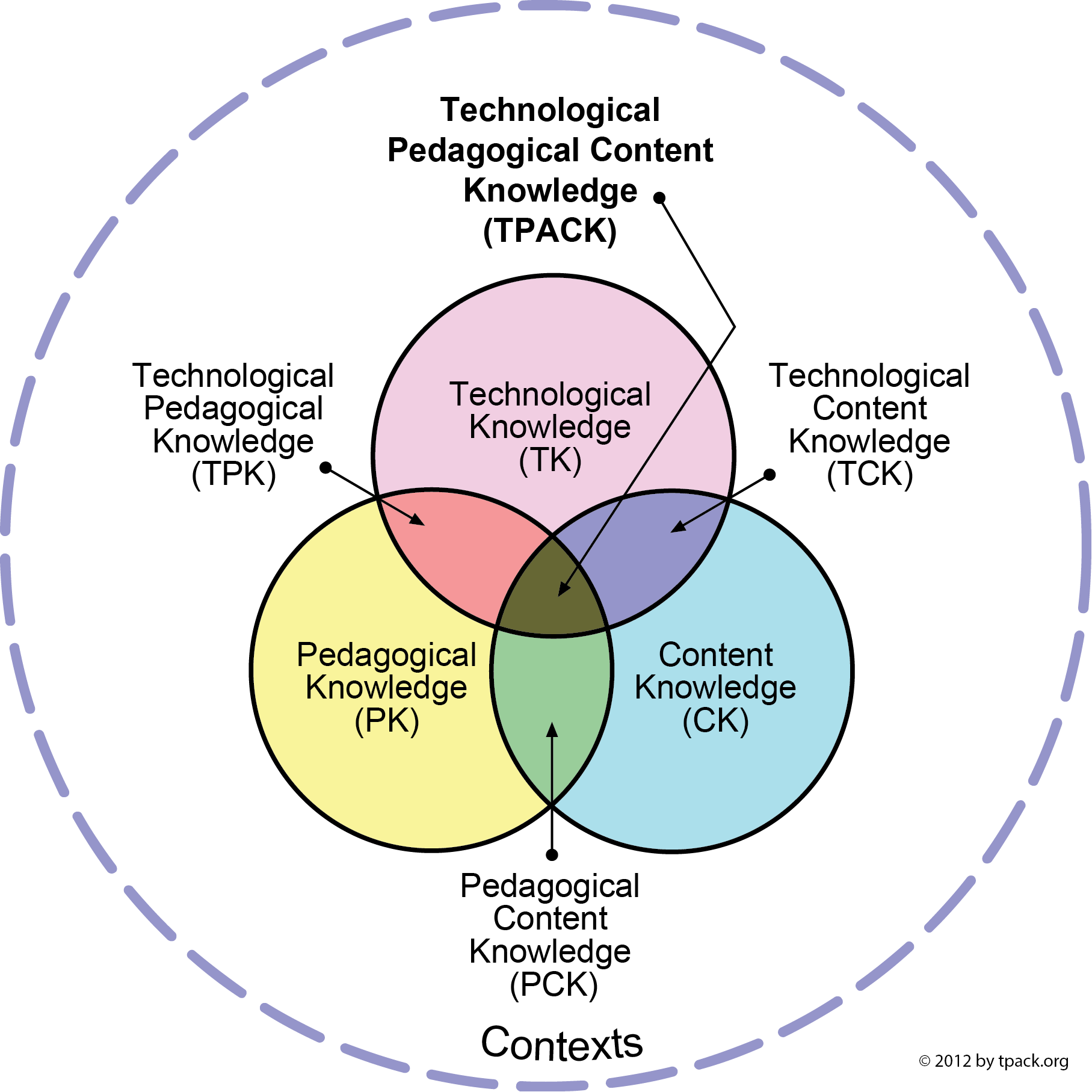
TPACK is a technology integration framework that identifies three types of knowledge instructors need to combine for successful edtech integration technological, pedagogical, and content knowledge.
The TPACK acronym, located in the middle of the diagram, stands for a thorough comprehension of how to use technology in the classroom. Remember that this is not the same as being familiar with the three main themes separately. The goal of TPACK is to discover how to teach topics using technology in a way that improves student learning experiences.
It takes growing sensitivity to the dynamic, transactional link between various components of knowledge situated in specific contexts for technology integration for pedagogy around a given subject matter to be effective. Every circumstance is unique due to the fact that every instructor, every course, and every point of view on teaching is different, as well as elements such as grade level, school-specific factors, demography, culture, and others.
TIM
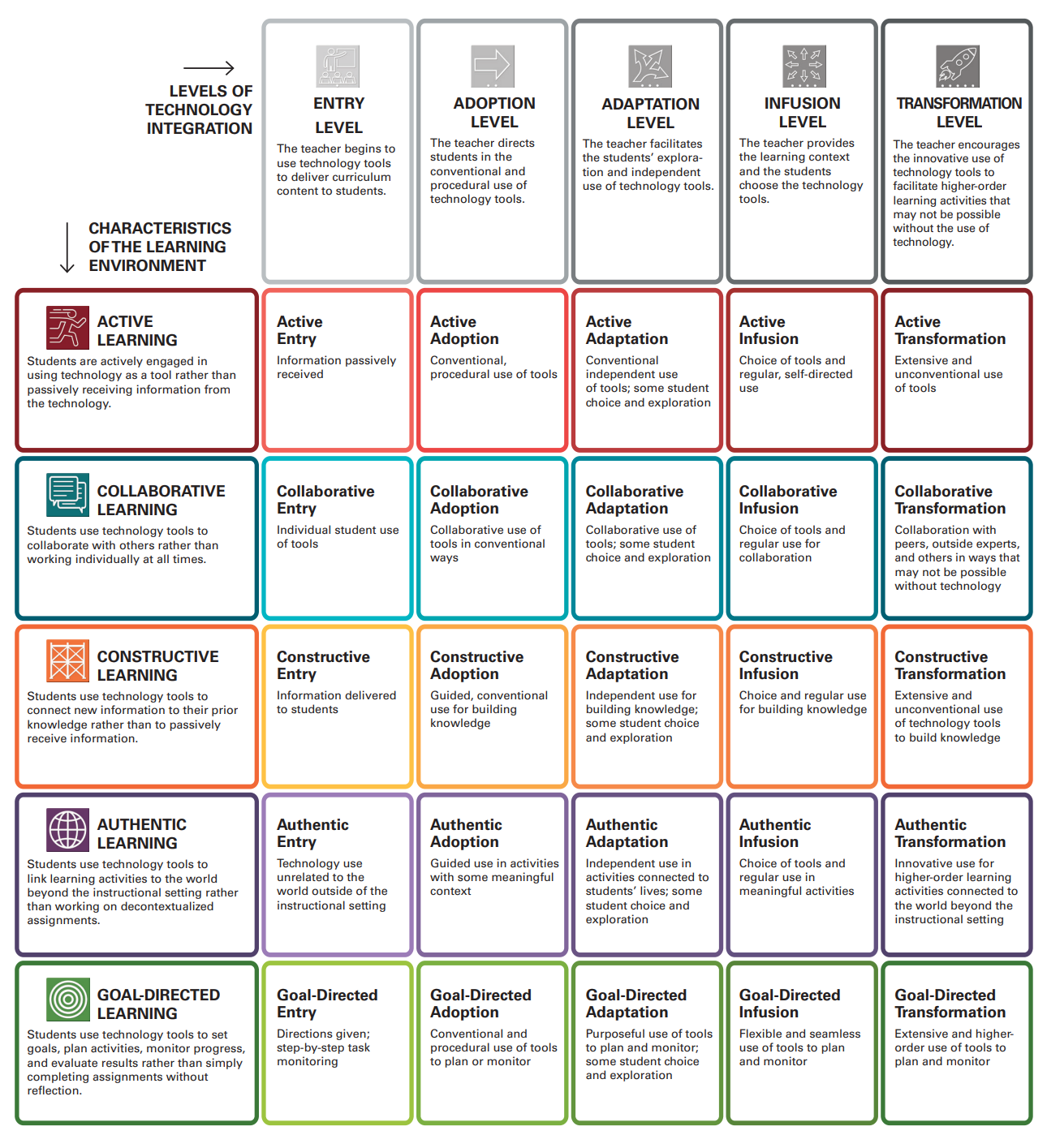
TIM is the Technology Integration Matrix (TIM) framework for characterising and directing the use of technology to improve learning. Active, collaborative, constructive, authentic, and goal-directed learning settings are five interrelated aspects of the TIM. The five levels of technological integration—entry, adoption, adaptation, infusion, and transformation—are related to these traits. A matrix of 25 cells is created by the five qualities of relevant learning environments and the five levels of technology integration.
The difficult work of assessing technology integration in the classroom was made easier with the development of the Technology Integration Matrix (TIM). It gives educators like teachers, school administrators, coaches, researchers, evaluators, and facilitators of professional development a shared vocabulary for pedagogically effective technology integration. The constructivist learning theory and research on teacher practise serve as the foundation for the TIM's theoretical framework. The TIM is a paradigm for technology integration that is intended to evaluate a lesson rather than a teacher or a specific assignment, in contrast to other models.
Project-Based Learning

Through active exploration of real-world issues and difficulties, students actively engage in project-based learning, which helps them learn transferable skills.
Over a prolonged period of time, students work on a project that requires them to address a challenging subject or solve a real-world problem. By producing a public product or presentation for a real audience, they showcase their expertise and abilities.
Students gain profound content understanding as well as critical thinking, teamwork, creativity, and communication abilities as a result. Students and teachers are given the opportunity to express their creativity via project-based learning.
ISTE
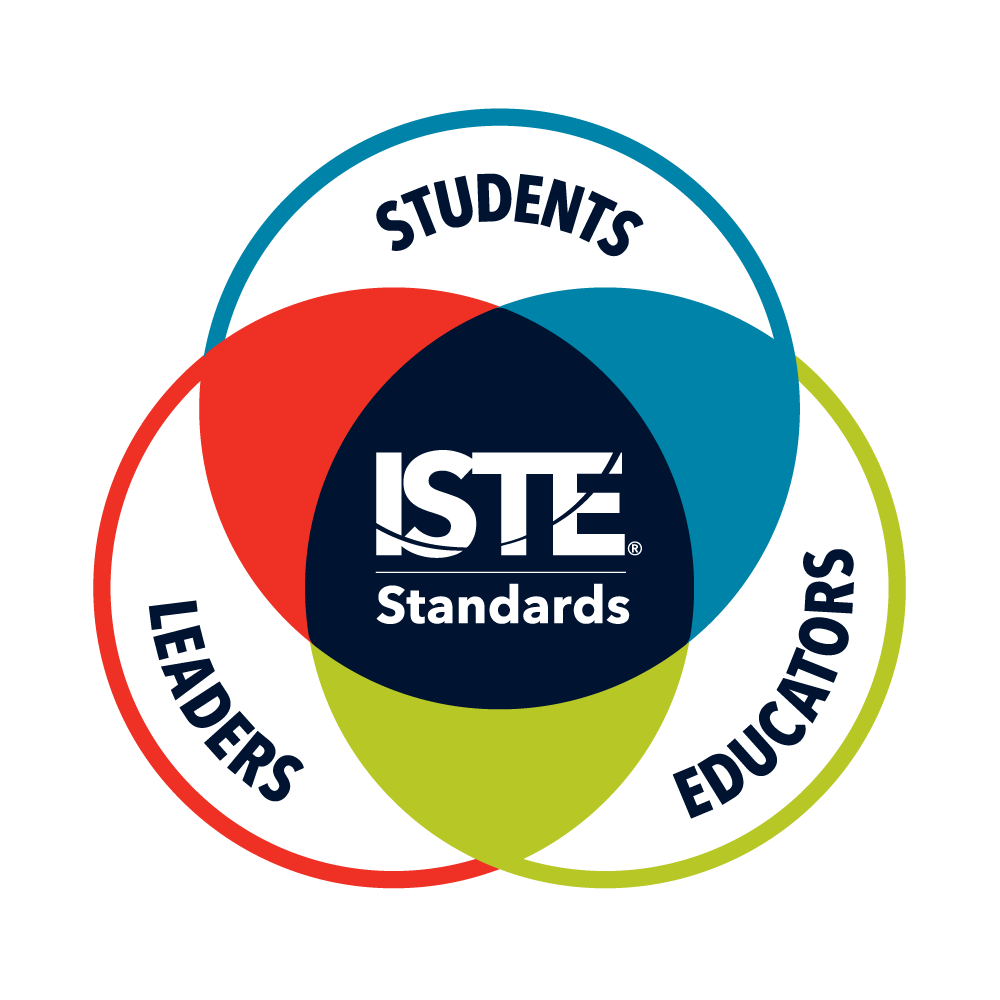
The ISTE Standards offer the skills for learning, teaching, and leading in the digital era, offering a thorough road map for the efficient use of technology in classrooms all across the world. The ISTE Standards ensure that employing technology for learning may provide high-impact, sustainable, scalable, and equitable learning experiences for all learners. They are founded in learning science research and built on practitioner experience.
The best way that technology may improve learning is when educators consciously include it into the adopted curriculum. A curricular framework is required to connect established content standards with digital curriculum materials that are in line with the content learning objectives as part of any system-wide project.
Technology use for learning is guided by a curriculum framework both in terms of how and when. It guarantees that technology is used: to address practical skills; to gain the appropriate skills at the appropriate times for the appropriate purposes; to achieve certain learning goals.